

AI: A Driver of Inflation or Disinflation?


Key Takeaways
- The AI revolution promises to increase output while lowering production costs.
- Thirty years ago, the information and communications technology (ICT) revolution delivered similar benefits, although it ultimately fueled market excesses.
- The pace of AI development is so rapid that it is currently stimulating demand more than supply.
- In our view, while AI is likely to prove disinflationary over the long term, it is placing upward pressure on a number of prices today.
The emergence of a major technological shock invariably raises the same economic questions. The first concerns measurement: meaningful analysis depends on reliable data. The second relates to its impact on the organization of work. The third—and most important for central bankers—is its effect on prices.
Measuring the AI Revolution: A Statistical Challenge
Federal Reserve Chairman Kevin Warsh is convinced that the artificial intelligence revolution will lead to faster economic growth without generating inflation. For monetary policy, the logical implication would be a sustained easing bias. His view is reminiscent of Alan Greenspan’s position three decades ago, when he led the Federal Reserve and observed the rise of information and communications technologies. Following Greenspan’s recent passing, many tributes emphasized how prescient he had been. The ICT wave boosted productivity and strengthened economic growth without triggering overheating. This is precisely the favorable scenario Warsh hopes to see repeated.
Revisiting some of Greenspan’s remarks from 1996 offers valuable perspective on the technological transformation unfolding today, despite important differences, particularly in the speed of adoption. At the time, fewer than 300,000 websites existed worldwide, and the internet itself was barely five years old. The one-billion-website threshold would not be reached until 2016. By contrast, ChatGPT, launched at the end of 2022, surpassed one billion downloads within only a few months. AI is spreading far more rapidly than any previous major innovation.
Statistical data already capture the influence of AI across numerous sectors. In the United States, for example, spending on data center construction and imports of memory-storage capacity have risen sharply. Yet these indicators provide only a partial view. Defining the boundaries of a digital service is inherently more difficult than characterizing a physical product. Measuring its price and volume is equally challenging. Statistical frameworks inevitably lag behind the emergence of new production methods and business models.
AI and Employment: A New Industrial Revolution?
Thirty years ago, Greenspan struggled to reconcile data on profits, wages, and prices. He concluded that ICT had generated productivity gains not yet reflected in the official statistics. History ultimately validated that assessment. This suggests AI may produce similar effects, although such an outcome cannot simply be assumed. Among the initiatives Kevin Warsh launched upon taking office at the Federal Reserve is a dedicated effort to modernize statistical measurement.
Throughout modern history, every major technological advance has sparked questions—and often fears—about employment. During Britain’s Industrial Revolution, innovations such as the power loom directly threatened existing jobs and even provoked violent resistance from the Luddites. Later developments, including electricity, the internal combustion engine, and the computer age, rendered certain occupations obsolete while creating entirely new ones. In the end, living standards improved. Even so, the transition can generate significant disruptions. Job losses may occur well before new roles or tasks emerge. This remains an open question among economists and leading AI thinkers alike. Sam Altman, CEO of OpenAI, initially warned of a potential “Jobs Apocalypse” before later moderating that view.
The Inflation Debate: Productivity Gains versus Demand Pressures
For central bankers, the critical issue is inflation. In theory, a technological shock allows more output to be produced with fewer labor hours, which should help reduce price pressures. In practice, however, the broader economic environment matters greatly. Here again, the comparison with the 1990s is instructive. In the United States, that decade was characterized by fiscal consolidation, and beginning in 1998 the federal budget moved into surplus. Today’s situation is entirely different, with persistent federal deficits equivalent to roughly 6% of GDP. Internationally, the 1990s were marked by accelerating globalization, which exerted downward pressure on import prices and labor costs. It was later described as a “flat world,” largely free of friction—a stark contrast to today’s environment.
At present, the AI revolution is more visible through its impact on demand than on supply. It is contributing to higher prices across a range of markets, including land for data center construction, electricity required to power those facilities, and, through spillover effects, even consumer technology products (see graph). AI’s extraordinary appetite for semiconductors has pushed the prices of PC-related components back to levels last seen five years ago.
Ultimately, the long-term impact of AI on inflation remains uncertain. Some economists argue that technological shocks tend to be disinflationary when they are largely unexpected—as was the case with ICTs. By contrast, they contend that when a technological revolution is widely anticipated, as with AI, it may initially exert upward pressure on prices.
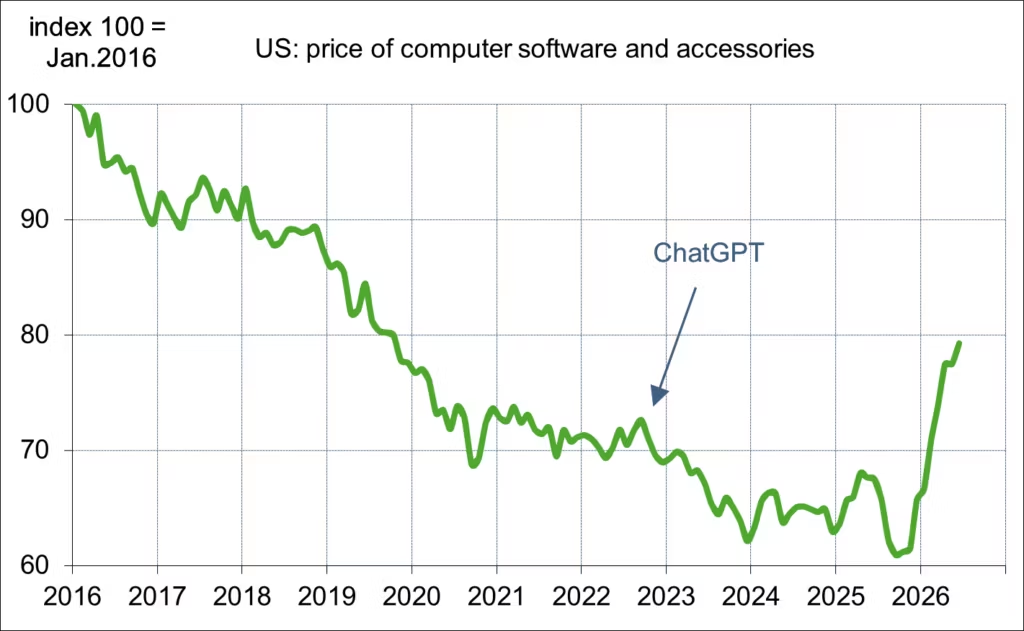
Source: ODDO BHF
Finally, AI has become a major equity-market phenomenon with significant implications for global financial conditions. As early as 1996, Greenspan questioned what he famously described as “irrational exuberance” in financial markets. He ultimately allowed the boom to continue until the technology bubble burst in 2001. Once again, parallels with the current environment are difficult to ignore, particularly as the leading AI companies prepare—following the example of SpaceX—for future public market listings.
Past performance is not a reliable indicator of future returns and is subject to fluctuation over time. Performance may rise or fall for investments with foreign currency exposure due to exchange rate fluctuations. Emerging markets may be subject to more political, economic or structural challenges than developed markets, which may result in a higher risk
Disclaimer
This document has been prepared by ODDO BHF for information purposes only. It does not create any obligations on the part of ODDO BHF. The opinions expressed in this document correspond to the market expectations of ODDO BHF at the time of publication. They may change according to market conditions and ODDO BHF cannot be held contractually responsible for them. Any references to single stocks have been included for illustrative purposes only. Before investing in any asset class, it is strongly recommended that potential investors make detailed enquiries about the risks to which these asset classes are exposed, in particular the risk of capital loss.
ODDO BHF
12, boulevard de la Madeleine – 75440 Paris Cedex 09 France – Phone: 33(0)1 44 51 85 00 – Fax: 33(0)1 44 51 85 10 –
www.oddo-bhf.com ODDO BHF SCA, a limited partnership limited by shares with a capital of €73,193,472 – RCS 652 027 384 Paris – approved as a credit institution by the Autorité de Contrôle Prudentiel et de Résolution (ACPR) and registered with ORIAS as an insurance broker under number 08046444. – www.oddo-bhf.com
Author