
Energy Shock, Technology Shock: What Comes Next?


Key messages
- The surge in energy prices triggered a moderate inflationary shock.
- Central banks have been compelled to adopt a somewhat more restrictive monetary policy stance.
- Barring a new geopolitical crisis, inflation is expected to continue moderating through 2027.
- The resilience of the U.S. economy has been driven in large part by the artificial intelligence boom.
- Concerns are emerging that investment levels may have become excessive, creating potential risks to financial stability.
- U.S. household and foreign investor exposure to the U.S. equity market has reached unprecedented levels.
In 2026, the global economy has been shaped by two major shocks: an energy shock stemming from the conflict in the Middle East, and a technological shock driven by the deployment of artificial intelligence. The first has predictably weighed on economic activity while fueling inflation, a pattern observed repeatedly throughout history. The second, by contrast, has supported growth by stimulating investment. Its impact on prices is more ambiguous and depends largely on the time horizon considered. Economic prospects will depend to a significant extent on how these two shocks evolve. Have they already peaked? Could they intensify further? Or is there a risk of a reversal that could offset the positive or negative effects of the initial shock?
Let us first consider the energy shock
Nine months ago, at the onset of the U.S.-Iran conflict, the oil market, which had previously been characterized by a modest supply surplus, abruptly shifted into a state of severe deficit. Roughly one-fifth of global oil flows were suddenly disrupted. Given the scale and unexpected nature of the disruption, experts at the International Energy Agency (IEA) described it at the time as the most severe oil shock in history.
More recently, the IEA suggested that the world could eventually reduce its dependence on the Strait of Hormuz, provided sufficient investment is made to develop alternative routes. Indeed, a significant share of oil flows has already been rerouted this year, while demand-side adjustments have helped absorb the shock with relatively limited economic damage. The global economy is not in recession, nor are the major net energy-importing countries. In reality, the world is not facing a shortage of crude oil itself, but rather of refined products, owing to considerable constraints on refining capacity.
From an economic standpoint, the energy shock has led to higher consumer prices. This was unavoidable, as some of the affected products have no immediate substitutes. There have also been indirect effects through higher production costs for a broad range of goods and services. However, there is no tangible evidence of a wage-price spiral. Overall, since January 2026, before the outbreak of the Middle East conflict, inflation has risen by 1.5 percentage points in the United States to 4.0%, by 2.5 percentage points in the euro area to 4.0%, and by 0.5 percentage point in China to 0.7%.
While meaningful, this inflationary surge remains moderate compared with the shock experienced in 2022-2023. Nevertheless, it has negatively affected purchasing power and, by extension, consumer spending. Several governments have introduced targeted measures to cushion the impact, particularly for energy-intensive industries, but fiscal room is limited in most economies. Households have borne much of the burden, contributing to a widespread sense of economic pessimism across developed countries and growing dissatisfaction with incumbent governments. The Republican Party’s significant losses in the midterm elections have been widely attributed to the energy shock.
In response, central banks have moved toward a more restrictive monetary policy stance. While monetary policy cannot directly influence energy markets, it can moderate demand and help prevent medium-term inflation expectations from becoming unanchored. The European Central Bank acted first, raising interest rates in June and September, with another increase expected in December. The U.S. Federal Reserve responded more gradually and now appears compelled to catch up. Following a rate hike in September, another increase is expected by year-end and likely one more in early 2027. Unless geopolitical tensions escalate further, it is reasonable to anticipate a renewed disinflationary trend in 2027, which should reduce the incentive for central banks to continue tightening policy aggressively.
Turning now to the technological shock
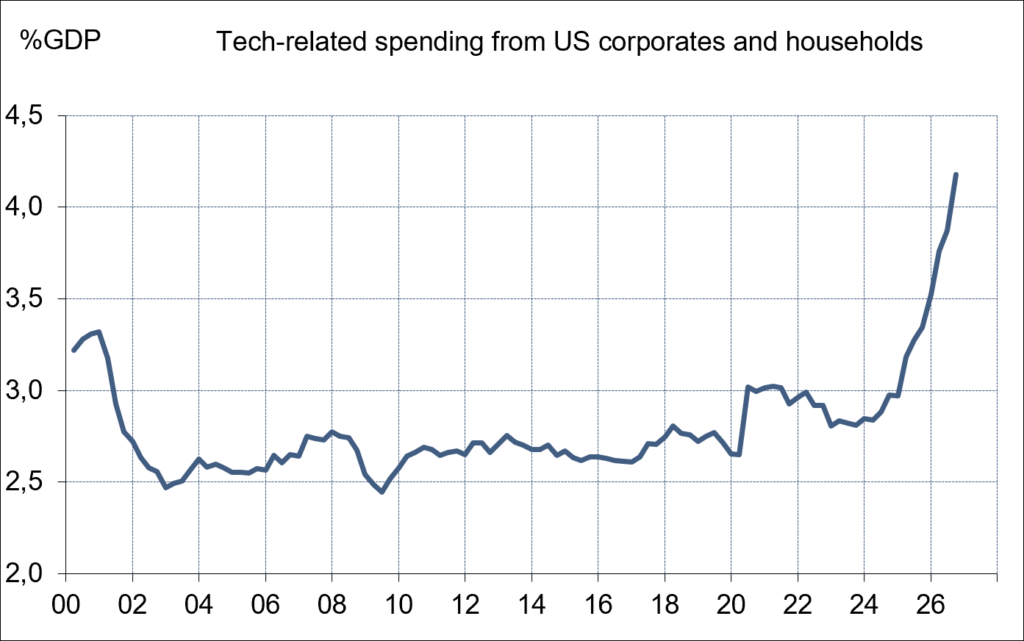
Artificial intelligence became a reality for the broader public four years ago with the launch of ChatGPT. At the time, many viewed it as little more than a novelty. Today, however, the massive capital expenditures required for its deployment have transformed AI into one of the primary drivers of economic growth. The impact of this investment boom is particularly visible in the United States, where spending on technology-related products has accelerated at an unprecedented pace over the past two years. After remaining broadly stable at approximately 2.7% of GDP for two decades, technology investment has recently climbed to 4.2% of GDP, significantly surpassing the peak reached during the dot-com era in 2000.
Source: ODDO BHF
Measuring AI’s contribution to overall economic output remains a subject of debate among economists. Based on investment volumes and imports of related equipment, it can be estimated that AI-related spending accounted for between 25% and 30% of U.S. GDP growth in 2026, despite representing only a fraction of that share in the economy itself.
The current investment surge is the largest on record. According to a recent study by the Brookings Institution, AI deployment spending is projected to average 3.6% of GDP annually between 2025 and 2032. Previous investment booms involved smaller amounts spread over much longer periods. The same study estimates investment at 2.2% of GDP for the railroad expansion era (1870-1890), 1.1% for the interstate highway buildout (1956-1973), and 1.1% for the telecommunications boom (1996-2003). Virtually all AI-related metrics, including investment, equipment imports, and pricing trends, are currently following exponential trajectories. While the potential productivity gains associated with AI should not be dismissed, the scale and pace of spending increasingly raise concerns about possible overinvestment.
Such trends are not indefinitely sustainable, nor would that be desirable. Recent turbulence among several companies within the AI ecosystem has already prompted investors to question prevailing valuation levels. Public opposition to the construction of new data centers is growing in some regions. Certain policymakers favor tighter restrictions on these projects, while others advocate broader regulation of AI technologies. Excessive capital expenditure ultimately reflects a misallocation of resources. Economic history offers numerous examples of investment booms ending in sharp corrections, particularly when excesses are denied for too long and supported by opaque or unstable financing structures. The dot-com bubble remains a notable case in point.
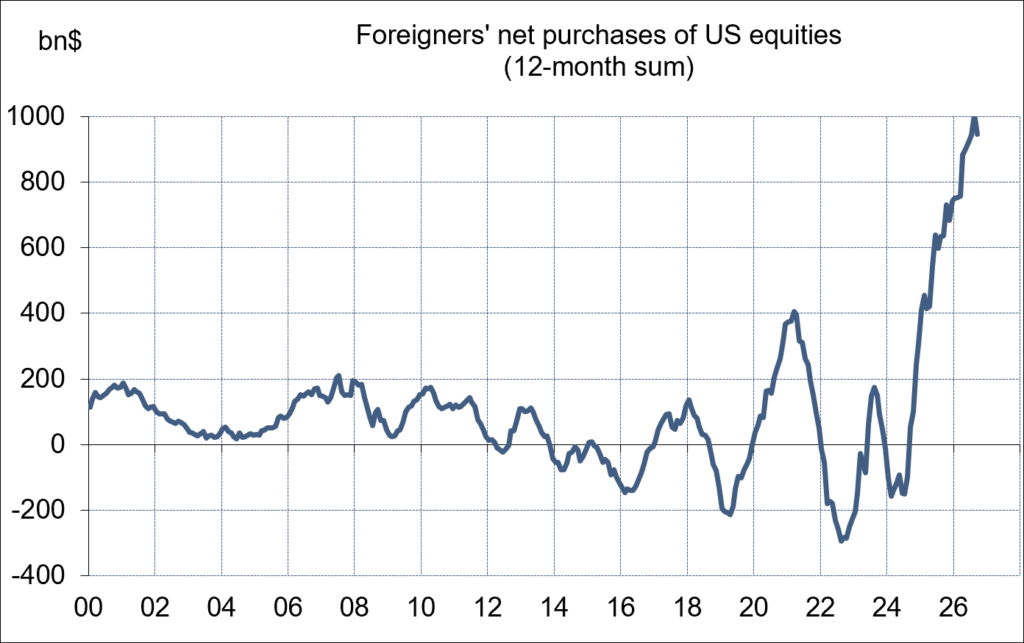
There are, of course, important differences between that episode and today’s environment. Nevertheless, the current acceleration in AI-related investment raises legitimate questions about financial stability. In the United States, households now hold 43% of their financial wealth in equities, a market increasingly driven by AI-related companies. This represents an exposure level ten percentage points higher than at the peak of the dot-com era in 2000. Foreign investors are similarly exposed. On a rolling twelve-month basis, net purchases of U.S. equities by overseas investors have reached $1 trillion, another unprecedented milestone.
Source: ODDO BHF
If the wealth effect were to reverse, consumer spending would likely come under pressure. Even without a full-blown equity market correction, a slowdown in AI-related investment spending could be enough to weaken economic growth, initially in the United States and, through spillover effects, across the global economy.
Author