

A New Era of Higher Interest Rates


Key Takeaways
- Public finances, inflation, political risk, and artificial intelligence are all contributing to upward pressure on long-term interest rates.
- Bond yields have risen to their highest levels in roughly two decades.
- In both the United States and Europe, current yield levels remain broadly consistent with economic fundamentals.
- This new era of elevated interest rates is increasing pressure on the most heavily indebted countries.
A Global Economy Demonstrating Resilience Amid Geopolitical Shocks
The global economy continues to display a remarkable capacity to withstand external shocks. Last year, markets had to navigate the fluctuations of U.S. tariff policy; this year, attention has shifted to renewed instability stemming from the conflict in the Middle East. In both cases, economic actors have had to contend with an unpredictable “Trump factor.”
Once the initial uncertainty subsides, businesses and consumers tend to adapt, limiting the longer-term economic impact. Global trade is less fluid than it was two years ago, while tanker traffic through the Gulf remains constrained. Nevertheless, much of the disruption to economic activity has been absorbed. Business sentiment indicators weakened last spring but recovered meaningfully over the summer. By mid-2026, global GDP growth was running at approximately 3.1%, compared with nearly 3.5% a year earlier. The slowdown remains modest. The global economy continues the expansion phase that began in 2021 following the COVID crisis.
Artificial Intelligence: A New Growth Engine and a Source of Emerging Risks
Offsetting the negative effects of Middle East tensions is the powerful positive impulse generated by investment in artificial intelligence. Adoption rates have accelerated rapidly. A U.S. Census Bureau survey of a broad cross-section of American companies found that 22% are already using AI tools. Until recently, such adoption was confined to a relatively small segment of businesses. Four years ago, ChatGPT had not yet been launched.
In the United States, spending on information-processing equipment and software, which currently represents roughly 7% of real GDP, contributed nearly as much to economic growth over the past year as the remaining 93% of the economy combined. Over the last three years, construction expenditures dedicated to data centers have increased more than fourfold.
However, trends of this magnitude cannot continue indefinitely. A sharper-than-expected slowdown in AI-related investment could deprive the global economy of one of its key growth drivers. This represents an important risk to monitor. AI also creates additional challenges in areas such as financial markets, where it could contribute to valuation corrections, and cybersecurity. More broadly, some recent warnings have highlighted potential long-term risks associated with the technology.
The AI boom is also influencing monetary dynamics. Whether AI is ultimately inflationary or disinflationary remains a subject of significant debate among central bankers. The answer is unlikely to be binary. Over the medium to long term, AI is expected to enhance productivity and, all else being equal, ease pressure on productive capacity and prices. For now, however, AI is primarily stimulating demand for specific products, in some cases creating shortages in areas such as memory chips and semiconductors. These imbalances are driving prices higher. From a growth perspective, oil and AI are exerting opposing influences; from an inflation standpoint, their effects are cumulative.
Inflation, Central Banks, and the Transition to a Higher-Rate Environment
Inflation risks remain skewed to the upside. Prior to the U.S.-Iran conflict, global inflation was trending at roughly 2.5% annually; it is now approaching 3.5%. While far below the double-digit inflation experienced in many advanced economies during 2021 and 2022, central banks remain mindful that their earlier response was widely viewed as delayed. As a result, they are determined to reinforce their commitment to restoring inflation to their 2% target.
Paradoxically, among major central banks, the European Central Bank has responded most quickly, despite inflationary pressures being less acute in the euro area than in other regions, particularly the United States. In Europe, wage growth remains contained, corporate pricing power is generally limited, and fiscal policies are not especially expansionary, with Germany being a notable exception. Second-round effects from earlier energy price shocks have largely failed to materialize. Following two policy rate increases, the ECB’s monetary stance still appears broadly neutral for the economy. Additional tightening, however, could place greater pressure on economic activity and credit conditions.
In the United States, inflationary pressures have proven more persistent and widespread. At the start of 2026, the Federal Reserve appeared inclined toward rate cuts, and its newly appointed Chair, selected by President Trump, was widely expected to support that direction. During the summer, however, the Federal Open Market Committee shifted course. By September, policymakers were unanimous in favor of raising interest rates. This development is significant for two reasons. First, it reinforces the Federal Reserve’s anti-inflation credibility. Another rate increase before year-end appears highly likely. Second, it demonstrates the institution’s independence from the White House. As long as doubts persisted on this front, investors demanded a higher risk premium on interest rates.
Bond yields have now reached levels not seen in approximately twenty years. One of the primary drivers is the deterioration of public finances. Government debt has resumed its upward trajectory since 2023. Following each major crisis, whether the 2008 financial crisis or the 2020 pandemic, debt levels surge, while subsequent fiscal adjustments tend to be gradual, limited, and short-lived. At the same time, maturing debt must increasingly be refinanced at higher interest rates. Budget deficits are also being fueled by demographic aging and the associated rise in healthcare and pension expenditures. Compounding these pressures, AI-related companies require substantial capital and are now competing directly with sovereign issuers for investor funding. In short, the era of ultra-low interest rates has definitively come to an end. A new regime of structurally higher rates is now taking shape.
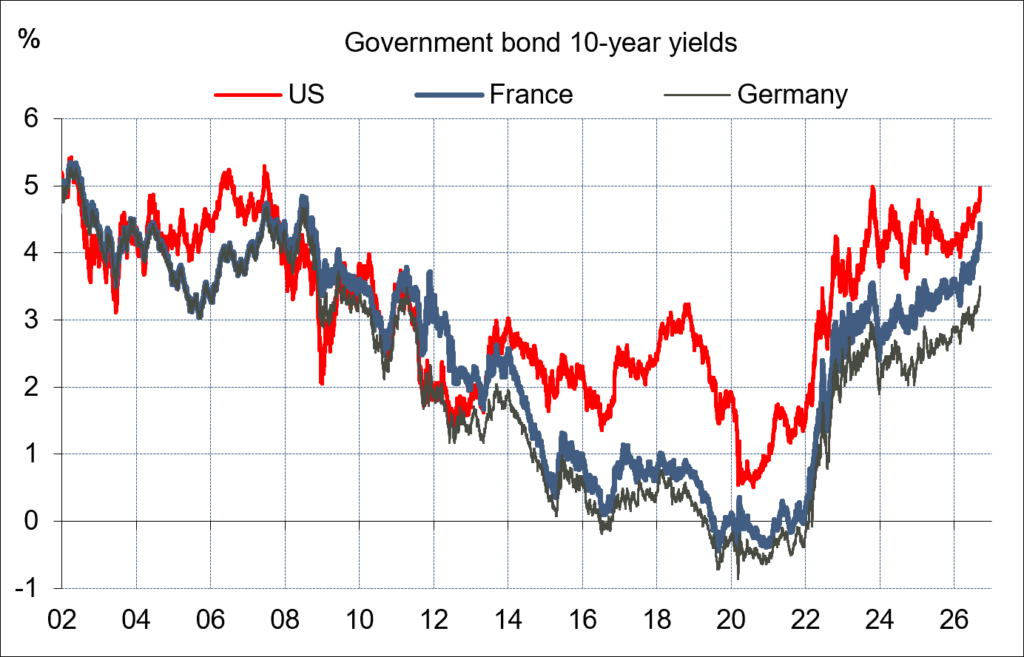
Source: ODDO BHF
Past performance is not a reliable indicator of future returns and is subject to fluctuation over time. Performance may rise or fall for investments with foreign currency exposure due to exchange rate fluctuations. Emerging markets may be subject to more political, economic or structural challenges than developed markets, which may result in a higher risk
Disclaimer
This document has been prepared by ODDO BHF for information purposes only. It does not create any obligations on the part of ODDO BHF. The opinions expressed in this document correspond to the market expectations of ODDO BHF at the time of publication. They may change according to market conditions and ODDO BHF cannot be held contractually responsible for them. Any references to single stocks have been included for illustrative purposes only. Before investing in any asset class, it is strongly recommended that potential investors make detailed enquiries about the risks to which these asset classes are exposed, in particular the risk of capital loss.
ODDO BHF
12, boulevard de la Madeleine – 75440 Paris Cedex 09 France – Phone: 33(0)1 44 51 85 00 – Fax: 33(0)1 44 51 85 10 –
www.oddo-bhf.com ODDO BHF SCA, a limited partnership limited by shares with a capital of €73,193,472 – RCS 652 027 384 Paris – approved as a credit institution by the Autorité de Contrôle Prudentiel et de Résolution (ACPR) and registered with ORIAS as an insurance broker under number 08046444. – www.oddo-bhf.com
Author