

French risk: the dangerous liaisons between politics and the budget


Key Takeaways
- France’s budget deficits are structural, not cyclical
- The interest rate shock is increasing the pressure to break the deadlock
- In this regard, passing a budget before the end of the year is an essential first step
- Political fragmentation stands in the way of any sustainable fiscal adjustment plan
- An election campaign is, by its very nature, not conducive to announcing unpopular reforms
- In the medium term, restoring credibility requires reducing the size of the welfare state
With seven months to go until the presidential election in France, the nature of the perceived risk has changed. The uncertainty is no longer merely institutional or political. It also concerns the state’s financing conditions, business confidence and the economic outlook. Given the weight of the French economy, this may have knock-on effects on neighbouring countries and the eurozone as a whole.
France is coming to the end of a political cycle (ten years of Emmanuel Macron’s presidency) and a financial cycle (several decades of fiscal laxity). The dissolution of the National Assembly in June 2024 has exacerbated the fragmentation of the Assembly. There are three irreconcilable blocs, of roughly equal size. One on the left, dominated by Jean-Luc Mélenchon’s La France Insoumise. The other on the right, represented by Marine Le Pen’s Rassemblement National. In the centre are various parties that support the government but account for only 29 per cent of the seats. Under these circumstances, without a stable majority, devising and then implementing a plan to restore public finances to health is an almost impossible task.
Opinion polls currently show Marine Le Pen with a significant lead, with 30 to 35 per cent of voting intentions in the first round. The main uncertainty concerns her opponent in the second round, with Édouard Philippe in the centre and Jean-Luc Mélenchon on the left currently best placed. These polls should, however, be interpreted with caution. With the election still so far off, not all candidates have yet been finalised and unforeseen events could disrupt the campaign. In the last eight presidential elections, the rankings observed so far in advance of the vote proved accurate in only half of the cases.
Political uncertainty does not end with the election of a new president on 2 May. The winner will have to call new parliamentary elections in order to secure a parliamentary majority and thus the ability to govern. This is what has almost always been the case in the past, but there is no 100 per cent guarantee.
Large, persistent and, above all, structural public deficits
At the start of the Macron era, France had brought its budget deficit below 3 per cent of GDP in 2018 and 2019. The 2020 health crisis, followed by energy shocks, have severely deteriorated public finances. These crises have also affected other European economies. This cannot serve as an excuse for the persistence of deficits exceeding 5 per cent of GDP.
In recent years, French growth has been close to its potential, meaning that the cyclical component of the deficit is minimal, at around 0.3 per cent of GDP out of a total deficit of 5.4 per cent. The deficit is, above all, structural. In particular, it reflects a very high level of public expenditure, at 57 per cent of GDP, the majority of which is accounted for by social spending. An adjustment relying solely on the reorganisation of the state, the fight against fraud or the elimination of administrative duplication would not be sufficient to tackle the problem. Pensions, healthcare and public sector employment cannot be left out of the debate.
France is currently subject to a European excessive deficit procedure. The Council has asked it to bring its deficit below 3 per cent of GDP by 2029 at the latest, whilst adhering to a strict public expenditure trajectory. This procedure was suspended in June 2026, but it has not been closed. Given the slippages already observed and the uncertainties surrounding the 2027 budget, a return to below 3 per cent by the scheduled deadline seems unlikely, even if measures are taken to curb spending.
The interest rate shock is exacerbating the debt dynamic
The rise in bond yields is a global shock that has intensified this summer. France is highly exposed to this due to its high level of public debt, which stands at around 120 per cent of GDP. The impact is not felt all at once, as the debt has an average maturity of more than eight years. But over time, the interest burden is growing. In 2020, at its lowest point, it stood at 30 billion euros. This year, it is 79 billion. Next year, it will likely exceed 90 billion. If policy remains unchanged, debt servicing could exceed 5 per cent of GDP by 2035 – double the current level. Rising interest rates are thus gradually reducing the resources available to fund other public priorities.
A government refinances itself at the rate dictated by the markets. If it is not deemed credible, the risk premium soars. This is typically measured by the OAT-Bund spread – the difference between French and German interest rates – which recently reached its highest level since 2011 (chart). To restore fiscal credibility, it is essential to improve the primary budget balance (i.e. excluding interest payments). In France, this stands at a deficit of 2.8 per cent of GDP. To stabilise the debt by 2030, it would need to turn into a surplus of one percentage point of GDP. The adjustment therefore amounts to 4 percentage points of GDP, or around 130 billion euros. This is entirely achievable within a few years; indeed, France has done so in the past. The obstacle lies in the fragility of the political and social situation.
A 2027 budget with fragile credibility
Due to political constraints, the draft budget for 2027 is not very ambitious: it targets a deficit of 5 per cent of GDP. The High Council for Public Finances estimates that this represents a structural effort of 0.8 percentage points of GDP, with two-thirds coming from additional revenue and the remainder from spending cuts.
Several underlying assumptions are fragile. Growth is forecast at 1 per cent in 2027, following 0.5 per cent in 2026, which assumes a rapid recovery in economic activity. The ten-year yield is expected to stand at 4.3 per cent by the end of 2027, well below the current level of close to 5 per cent. Finally, the adjustment involves politically sensitive measures, notably a partial freeze on pensions. It also involves extending a corporate tax surcharge, which weighs on companies’ competitiveness.
In the absence of a majority, the government has various options for passing a budget before the end of the year, but none are without risk. In 2024 and 2025, the government was brought down by motions of no confidence supported by all opposition parties. This threat remains. In the worst-case scenario, it is possible to implement the budget by decree, but this would mean bypassing Parliament.
The markets’ verdict
The rise in the French risk premium reflects a twofold uncertainty: partly political (who will be elected? to do what?), and partly due to the deterioration in public finances. More seriously, the speed of this adjustment signals a sudden shift in perception. For their part, the credit rating agencies will likely continue to downgrade the sovereign rating.
What are the consequences elsewhere? France is currently the weak link in the eurozone and, given its weight, there are signs of contagion spreading to other countries, such as Italy – another heavily indebted country, though with smaller deficits than France. At this stage, financial fragmentation between countries is far from reaching the levels seen in 2011 or 2020. There is no need to mobilise the ECB’s anti-fragmentation tool (TPI). In any case, whilst other countries might be eligible for it, this is not the case for France. Indeed, there is currently a broad consensus that the French risk premium is disconnected from the fundamentals.
In short, the solution lies within France itself, and not in the hope of external aid. As such, investors will be watching closely in the coming weeks to see whether a budget can be passed. Even if imperfect, the government’s current draft is generally heading in the right direction. In the longer term, restoring France’s fiscal credibility requires reforming the welfare state, which has become too costly, particularly the burden of pensions. It is on this point that Emmanuel Macron’s successor will be judged.
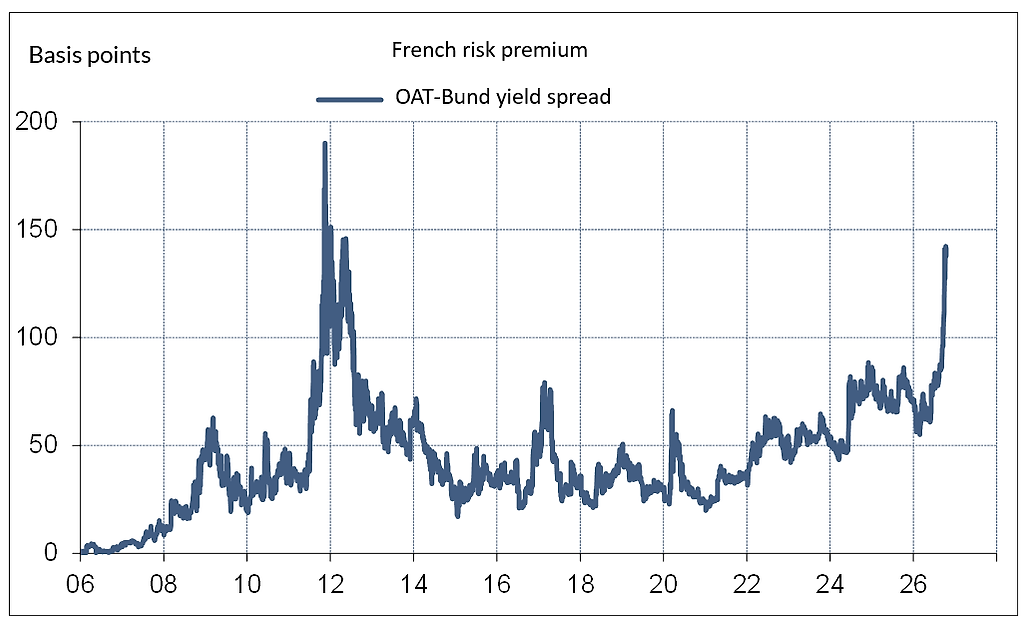
Source: ODDO BHF
Past performance is not a reliable indicator of future returns and is subject to fluctuation over time. Performance may rise or fall for investments with foreign currency exposure due to exchange rate fluctuations. Emerging markets may be subject to more political, economic or structural challenges than developed markets, which may result in a higher risk.
Disclaimer
This document has been prepared by ODDO BHF for information purposes only. It does not create any obligations on the part of ODDO BHF. The opinions expressed in this document correspond to the market expectations of ODDO BHF at the time of publication. They may change according to market conditions and ODDO BHF cannot be held contractually responsible for them. Any references to single stocks have been included for illustrative purposes only. Before investing in any asset class, it is strongly recommended that potential investors make detailed enquiries about the risks to which these asset classes are exposed, in particular the risk of capital loss.
ODDO BHF
12, boulevard de la Madeleine – 75440 Paris Cedex 09 France – Phone: 33(0)1 44 51 85 00 – Fax: 33(0)1 44 51 85 10 –
www.oddo-bhf.com ODDO BHF SCA, a limited partnership limited by shares with a capital of €73,193,472 – RCS 652 027 384 Paris – approved as a credit institution by the Autorité de Contrôle Prudentiel et de Résolution (ACPR) and registered with ORIAS as an insurance broker under number 08046444. – www.oddo-bhf.com
Author